Libby and the lodelure
"Quitters never win, kid."
Gently, you slid the glass from your left to mine.
"Not so," I said, "quitters draft first."
"This one is good," I said, "that one is a biohazard."
"I will get it," you sighed, taking the box of alcohol wipes to the passenger-side doors.
This was the third time in as many months that you'd locked the keys in the car, the second time a man named Martin had been sent to our aid in this parking lot near midnight; his tail lights now shrank south on the otherwise empty highway.
"You were right, by the way," you said, tearing two from the box and dropping it to the pavement.
"Well I know that," I muttered.
A smile.
"It was a gin frappuccino," you said.
"Oh."
I moved to the trunk - which Martin had inexplicably attempted to open twice - and slipped your yellow knife back under the spare.
"Damn," I marveled in midnight monotone, "what a rockstar."
Even with my head in the trunk, and you facing the windshield in the passenger seat, I felt your eyes light up the instant before you shouted,
"Lockstar!"
I pushed through the center panel of the back seat and whispered,
"Fuckyou!"
This particular corner is so far down and in, a 'professional' inspection might reasonably determine that it's been here since the earliest days of construction. Not so.
An analogy which comes to mind is the electricity present in a given house on the Fridays throughout its lifespan; needs work, but I've got enough concurrent charges in my veins at the moment just to navigate this place, and a long way left to go.
These things embed themselves in half-recalled hallowed halls and the undeveloped properties of naive bliss; places without the context of consequence. Weirdly, the lurid structures do not annex their neighbors as one might expect, or 'corrupt' them, like you might see in a movie. They blend almost seamlessly, and the only noticeable change within the preexisting corridors is that they see traffic.
Here, stepping down into the Ipatiev basement would feel very much like walking into a housewarming orgy.
That one, I'm sorry to note, isn't an analogy, or an assumption. Thankfully, neither of those are on this session's agenda.
Someone must be.
In one respect, she worries me: she relishes anticipation in a way that I can't wrap my head around, which makes it an unknown variable here. For her, waiting by the phone is the place to be, and the content of the incoming call is relatively unimportant.
The second time I sat down with her, I kept imagining her reaction in Sarah Connor's place at the fence; not a scene you'd catch in the broadcast cut.
I deduced/guessed that she probably hated surprises, which is how we were able to watch the first third, or so, of The Shining before I sprung the window on her.
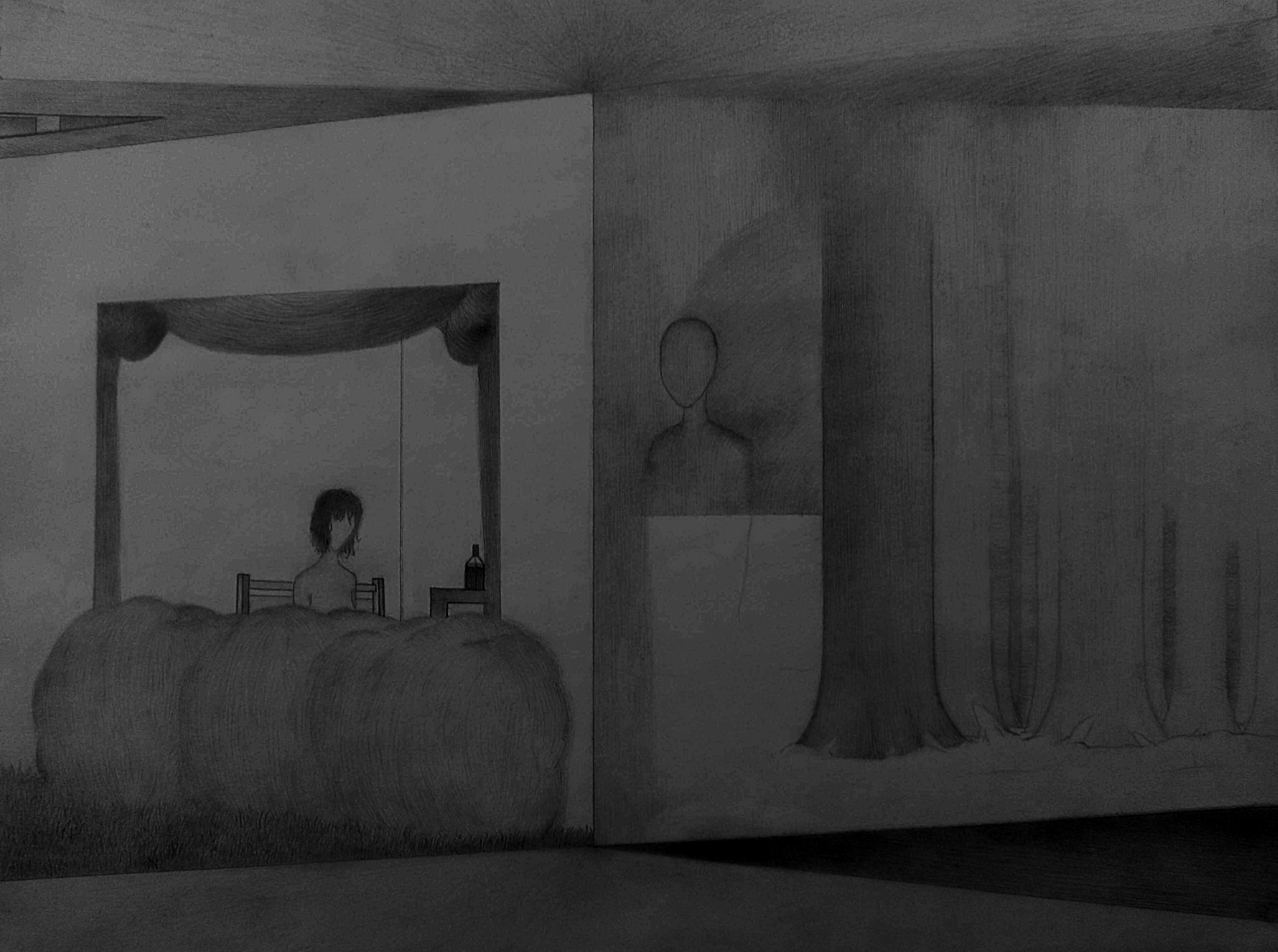
Sound had nowhere to go from the landing lounge but down the stairs.
I wasn't really the type to eavesdrop on anyone, let alone adults, let alone three ordained preachers who'd gone to the trouble of holding their conversation in a room behind a door which was ordinarily a wall concealed behind a floor-to-ceiling mirror; but they hadn't bothered closing the 'door' completely, or making sure they were alone in the basement of my pastor's house.
"Please, Joseph," the pastor said, "just listen."
Joseph had grown up in our church and spent a few years teaching Sunday school before becoming a preacher on the local evangelist circuit. Since then, he only returned 'home' once or twice each year to preach at our pastor's invitation, but he'd recently begun attending weekly services again.
The boys at the church had always revered him like a cool uncle, or older cousin; when he made his semiannual visits, they'd taken to calling him The Reverend Joe, which he seemed to get a kick out of. Since his sudden return though, he seemed distant, less affable than the guy we'd played unsanctioned moonlit baseball with at bible camp; when service ended, he wasn't around long enough for fellowship, or much more than passing handshakes with anyone between him and the front door.
"God's not a mediator between us and death," said the third man, not familiar to me, "nowhere in scripture-"
Joe cut him off,
"He is death."
"No, he is not- " the pastor started, but was overtaken by the third man;
"Joseph," he scolded.
"I'm not your boy, preacher," Joe snapped back.
"-he is not death, Joseph," the pastor's tone was almost pleading, but turned stern, "Sammy, you let it go."
I knew of Samuel, though it would be another couple of years before I put a face to the voice and reputation; a boy in my Sunday school class had attended a service at the church which Samuel pastored and was apparently still distressed by the mention of it a week later. Eventually I discovered a series of cassette tapes from a revival held by the same church in the eighties, and understood the kid's reaction; Samuel was aggressive, almost hostile toward the congregation -- which sounded massive -- and after some time berating them for betraying God daily and "sleeping with Satan" he instructed his deacons to "bring 'em in here I said, bring 'em in now!"
The remainder of the recording was difficult to make sense of, as the congregation slipped into some kind of ecstatic delirium when a number of television sets were brought into the sanctuary along with at least two sledgehammers.
"Then who?" Joe demanded.
The air in the house, even down the steps and around the corner, suddenly seemed very thin.
"Who?" Joe's voice cracked. "You tell me, Pop."
For a moment, it went very quiet; save for a sound I couldn't quite place. It might have been shuffling shoes, a sliding chair, a cough, a sob.
"Joe," the pastor said, almost too softly to be heard, even from the third step up.
"Mine says that without him is not anything made that is made. In mine, he says he takes no pleasure in her dying."
Joe had now slipped into pulpit enunciation, and volume, and might have gone on, but a flat, cold voice spoke instead;
"God," Samuel said, "is no respecter of persons."
A moment.
In well over a thousand sermons and his wife's eulogy, I never heard the pain which now pierced my pastor's voice;
"Please don't leave," he said, each syllable more choked with grief than the last.
I didn't understand, then, what I'd just heard in that brief, desperate final plea, but it seemed to move me, without any effort or intent on my part, backward and down from the stairs.
I was already halfway down the hall, stepping light and swift toward the library where I'd been when I first heard the voices, when I heard Joe's one last time, now unimpeded by the mirrored false wall,
"Well, brother," he said, "he's gonna respect that one."
The landing lounge houses at least two hidden ways; the first is behind the mirror-masked door, while the second is behind a wood panel in the closet adjacent to it. Compared to the secret office, a compartment packed with memorabilia from a fifty five year old film seems dull, somewhat anticlimactic; doesn't offer much incentive to unpack it and give the back 'wall' a knock.

The drawer was your idea.
Just after eleven, you texted me that you were stopping for groceries on your way home. My bank notifications gave me the play-by-play: twenty at the Shell station, ninety-one at the head shop, and two hundred fifty five at a fucking Walmart.
An hour later you were humming to yourself with half your body inside the pan cabinet, doing something to the underside of the silverware drawer with four boxes of brightly colored kitchen knives stacked on the counter above.
"Laundry, love," you said.
I must have heard you, but I was sorting five prescriptions into two weeks on the coffee table and it took the dryer's buzzer to snap me out of it.
"Crybaby," you shouted, "clothes!"
Once you were dressed, you walked me through it; four ordinary quarters and one from my old piggybank, mixed in with a handful of loose change, sliding around under the tray. The old quarter had been worn slightly concave on the tail side, and lay flat over a tiny screw with a string wound under its head. Lifting the quarter revealed the screwstring, pulling the string lifted the false floor and revealed a compartment with seven stringless screws holding two knives in place.
The remaining eighteen knives we carried out two at a time, a pair each night for the next nine nights in the city. On the eleventh, on the beach in the dark, you gave me one more box of six which had arrived that morning from across the sea behind us.